
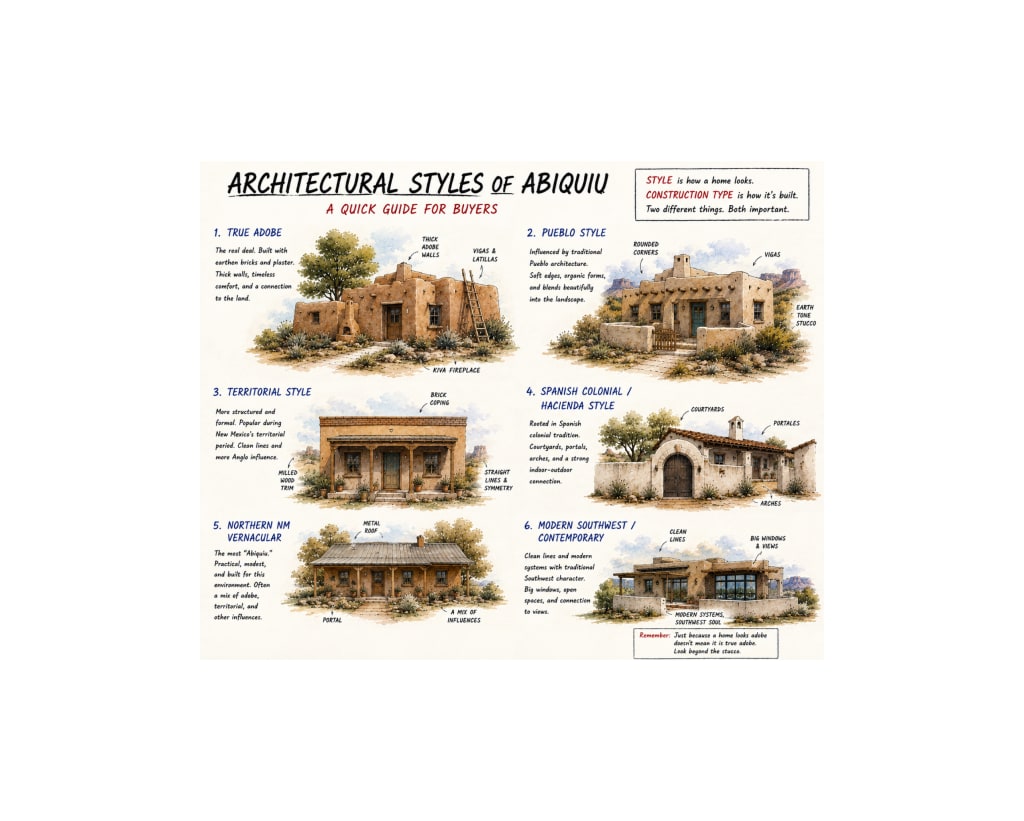

One of the biggest misconceptions I see with buyers in the Abiquiu area is the confusion between architectural style and construction type. People often use those terms interchangeably, but they are not the same thing.
Architectural style refers to how a home looks and the design elements that define its appearance. This includes features such as roof lines, parapets, vigas, latillas, rounded corners, window placement, courtyards, exposed beams, portals, and overall layout. When someone describes a home as Pueblo style, Territorial, Spanish Colonial, or Northern New Mexico style, they are talking about the visual design and character of the home.
Construction type refers to how the home was actually built and what materials were used to build it. This includes the structural system and wall composition, such as true adobe, wood frame, pumice block, concrete block, ICF, SIPs, modular construction, or manufactured construction.
The important thing to understand is that architectural style and construction type are completely independent of each other.
For example, a home may look like a classic adobe home with thick stucco walls, rounded corners, vigas, and traditional Southwest finishes, but it may actually be wood frame construction with a stucco exterior. Another home may have true adobe walls but incorporate Territorial style details such as brick coping, milled wood trim, and more formal window symmetry.
In other words, style tells you what the home looks like. Construction type tells you what is behind the stucco.
That distinction matters in real estate because construction type can affect financing, insurance, maintenance, energy efficiency, repair methods, and long-term ownership costs. Two homes may look nearly identical from the outside, but if one is true adobe and the other is frame with stucco, ownership considerations can be very different.
That is why, when evaluating real estate in Abiquiu, I always encourage buyers to look beyond appearance and understand how the home was actually built.